When parents separate, deciding what happens next for the children can be harder than many people expect. You might agree that the children should spend time with both parents, but disagree about how that should work in everyday life.
Perhaps one parent wants the children to stay overnight during the week, while the other thinks this will disrupt their school routine. You might disagree about weekends, Christmas, birthdays or who should take the children to their usual activities.
At first, these may seem like small disagreements. But when neither parent is willing to change their position, even a simple conversation can become stressful.
If you are in this situation, you may be considering family mediation or wondering whether it is time to apply to the family court.
Mediation Corby allows parents to sit down with the help of an impartial professional and work towards arrangements they can both accept. Going to court is different. If parents cannot resolve their disagreements, a judge may need to make the final decision.
So, which route should you consider? Here is what parents in England and Wales should understand before deciding.
Family Mediation or Court for Child Arrangements: What Is the Difference?
The main difference is who makes the decisions.
In family mediation Corby, you and your former partner discuss the arrangements with help from an impartial mediator. The mediator manages the conversation, helps identify the issues and encourages both parents to consider possible solutions.
They will not take sides or decide how much time the children should spend with either parent. That decision remains with you both. Also Read: How Long Does Family Mediation Take?
For example, imagine you disagree about where your children should spend their weekends. One parent wants alternate weekends, while the other would prefer the children to stay with them because of school and extracurricular activities.
Rather than continuing the same argument, mediation gives you a chance to look at the practical details and discuss an arrangement that could work for everyone.
You can discuss matters such as:
- Where the children will live and how much time they spend with each parent
- Weekday visits, weekends and overnight stays
- School holidays, Christmas and other important celebrations
- School collections, drop-offs and extracurricular activities
- Birthdays and family occasions
- Communication between parents about the children
- Changes to arrangements as the children grow older
Court proceedings are different. If you apply for a child arrangements order and the dispute cannot be resolved, a judge may make a decision about where the children live and when they spend time with each parent.
The court considers the child’s welfare as its paramount consideration. It will look at the individual circumstances rather than simply dividing time equally between parents.
Which option should you consider?
If you and your former partner can still have a conversation, mediation could be a good place to start, even if you don’t always see eye to eye. It gives you more involvement in deciding what everyday life will look like for your children.
If there are serious safety concerns, safeguarding issues or an urgent need for a court decision, mediation may not be appropriate. In those circumstances, getting legal advice about the available options is important.
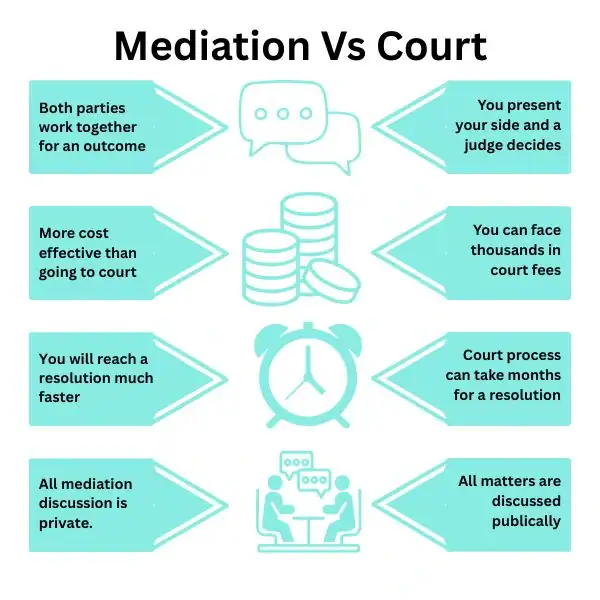
How Much Does Family Mediation Cost Compared With Going to Court?
Cost is understandably a concern, particularly when you are already dealing with the financial changes that often follow separation.
The cost of family mediation Corby depends on the mediator’s fees, the number of sessions required and whether you need help with other matters alongside child arrangements.
You will usually have an initial Mediation Information and Assessment Meeting (MIAM), followed by mediation sessions if both parents agree to proceed and the mediator considers it suitable.
Before booking, ask what the MIAM and subsequent sessions will cost. It is also worth checking whether there are any additional charges for preparing documents or other services.
There are two forms of financial support worth knowing about.
Legal aid
You may qualify for legal aid if your financial circumstances and the nature of your dispute meet the eligibility requirements.
Depending on the circumstances, legal aid can cover the MIAM and mediation sessions. If only one parent qualifies, the funding arrangements can also help cover certain initial costs for the other parent.
A mediator who provides legal aid work can explain what support may be available.
Family Mediation Voucher Scheme
Parents may also be able to receive up to £500 towards eligible child-related mediation sessions through the government’s Family Mediation Voucher Scheme.
There are some conditions to understand:
- The case must meet the scheme’s eligibility requirements.
- The mediator must be authorised to participate in the scheme.
- The voucher contributes towards mediation sessions, not the MIAM fee.
- Funding is subject to availability.
- It is a contribution towards the cost, not a guarantee that all your mediation fees will be covered.
Your mediator can explain whether your situation qualifies and whether funding is available.
What about court costs?
Court proceedings can involve an application fee, solicitor’s fees and additional expenses if the dispute continues through several hearings. The total depends on how complicated the case becomes and whether you need legal representation.
It is not possible to say that mediation will always be cheaper. However, finding out the likely cost of mediation before starting court proceedings can help you make a more informed decision.
Can Family Mediation Help You Agree Where the Children Live and When They See Each Parent?
Yes. Helping parents agree on practical child arrangements is one of the main reasons people use family mediation.
Sometimes the disagreement is about something specific. One parent may want additional overnight stays, while the other is concerned about how the children will manage the change.
In other families, the difficulty is that an existing arrangement no longer works. Perhaps one parent has changed jobs, the children have started a new school or travelling between two homes has become difficult. Also Read: Can My Ex Change Our Child’s School Without Asking Me?
These situations need more than a simple agreement about the number of days each parent gets.
During mediation, you can look at the details that affect your children’s everyday lives, including:
- Their school timetable and travel arrangements
- Their ages, routines and individual needs
- Relationships with both parents and wider family members
- Clubs, hobbies and other regular commitments
- Each parent’s work schedule
- How holidays and special occasions will be organised
For example, a parent who works shifts or regularly covers weekend hours may not be available for alternate-weekend contact. Mediation Corby gives both parents an opportunity to look at their schedules and agree on other times that work better for the children.
The aim is not to make everything equal on paper. It is to find an arrangement that takes account of the children’s needs and can realistically be followed.
What if your children are old enough to express their views?
Their feelings may also be relevant. Child-inclusive mediation Corby is an option in suitable cases, where a specially trained mediator can meet with a child separately to hear their views.
This is not something that happens automatically. It requires appropriate consent, the child’s willingness to participate and an assessment of whether it is suitable.
Children should not be made responsible for choosing between their parents. Their views can, however, help parents understand how the arrangements are affecting them.

What Happens If Your Ex-Partner Refuses Mediation or Will Not Compromise?
You might be ready to discuss things calmly, but what happens if your former partner refuses to attend?
This can be frustrating, especially when you feel that the children need a more settled routine and the current disagreements are affecting family life.
The important thing to understand is that you cannot force another parent to take part in mediation. Both people need to agree to participate.
You can book a MIAM yourself, even if your former partner is unwilling to attend. The mediator will discuss your situation, explain the process and help you understand whether mediation could work for you.
If your former partner does not attend or refuses to take part, the mediator can explain what happens next.
Do you need a MIAM before applying to court?
In most cases, parents must attend a MIAM before applying to the family court about child arrangements in England and Wales, unless an exemption applies.
There are exemptions. For example, some cases involving domestic abuse, child protection concerns or urgent circumstances may qualify. Also Read: What Happens to the Family Home When You Separate in the UK?
It is important to understand that attending a MIAM does not mean you must agree to mediation. It is an opportunity to consider whether mediation could help before taking the matter further.
If the other parent refuses to participate, or the mediator decides that mediation is unsuitable, you can consider making a court application where appropriate.
A refusal to mediate does not prevent you from exploring the legal options available to resolve the disagreement.

Is Family Mediation Suitable If There Is Conflict, Pressure or a History of Domestic Abuse?
Not every disagreement between separated parents can be resolved through ordinary joint mediation.
For some people, the difficulty is not simply that they disagree. They may feel intimidated, pressured or unable to express their views honestly in front of their former partner.
If you have experienced domestic abuse, controlling behaviour, threats or other serious concerns, tell the mediator before any joint session is arranged.
The mediator should assess whether mediation is suitable and whether you would be able to participate freely and safely.
Depending on the circumstances, different arrangements may be considered.
Shuttle mediation
In shuttle mediation, parents remain in separate rooms, and the mediator communicates between them. This avoids the need to sit together and discuss difficult issues face to face.
Online or remote mediation
Some parents find it easier to participate through separate video or telephone arrangements rather than attending the same location.
However, remote mediation is not automatically suitable for every situation. The mediator still needs to assess whether the process is safe and appropriate.
When might court be more appropriate?
Where there are serious safeguarding concerns, ongoing intimidation or a risk of harm, mediation may not be suitable. You may need legal advice about applying to court and any urgent protection that might be available.
You should never feel that you have to take part in mediation simply because you want to resolve arrangements for your children.
Your safety and ability to speak freely matter.
How Long Does Family Mediation Take Compared With a Court Case?
When arrangements for your children are uncertain, waiting months for a decision can be difficult for the whole family.
Mediation may provide a quicker way to address disagreements, particularly when both parents are prepared to take part and focus on finding a solution.
Some parents resolve child arrangement issues in one or two meetings. Others need more time, especially when there are several disagreements or communication has broken down.
There is no fixed number of sessions.
Court proceedings Corby can take considerably longer. The timescale depends on the court’s availability, the issues involved, whether reports or additional information are needed and how many hearings are required.
There is also a difference in how much control parents have over the process.
In mediation, you can focus on the issues that matter most to your family. You might agree on school holidays during one session and leave overnight arrangements for further discussion. Also Read: I’m Too Angry to Sit Down With My Ex — How Do I Prepare Myself Emotionally for Mediation?
Court proceedings follow a formal process, and the judge decides what needs to be considered before making an order.
It is worth remembering that mediation is not a guaranteed shortcut. If parents are unable to agree, court may still be necessary.
However, if there is a realistic opportunity to resolve the disagreement through discussion, it may be worth exploring before starting a court case.

What If Family Mediation Does Not Work? Can You Still Apply to Court?
Yes. Trying family mediation does not mean giving up your right to apply to court.
Sometimes parents reach an agreement on most issues but cannot resolve one particular disagreement. For example, you might agree on weekday arrangements but remain unable to agree about where the children should spend Christmas.
In other situations, discussions may not lead to any agreement at all.
If mediation does not resolve the dispute, you can consider the remaining options. This may include obtaining legal advice and applying for a child arrangements order.
What happens if you reach an agreement?
Once you have agreed on the arrangements, the mediator can help document what you have decided so you both have a clear record to refer to later.
This can provide a useful record of the arrangements and help avoid misunderstandings later.
However, an agreement reached through mediation is not automatically legally binding.
If you want a legally binding arrangement, you can speak to a solicitor about preparing a consent order and applying to the court for approval. Also Read: Co-Parenting After Separation: How Mediation Can Help You Both Move Forward
The court will consider whether the proposed order is appropriate, with the child’s welfare remaining central to its decision.
The important thing is to understand that mediation and court are not necessarily competing choices. Mediation gives parents an opportunity to resolve disagreements themselves. Court remains an option when an agreement cannot be reached or formal intervention is needed.
How Barker Mediation Corby Can Help You With Child Arrangements
When communication with your former partner has become difficult, even discussing everyday arrangements can feel like another argument waiting to happen.
You may both want the children to have a settled routine, but have different ideas about what that should look like.
At Barker Mediation Corby, we help separated parents discuss the issues affecting their children in a structured and impartial setting.
Whether you are struggling to agree on overnight stays, school holidays, birthdays or the practicalities of managing two households, mediation provides an opportunity to talk through the options with professional support.
You do not need to arrive with a complete plan or know exactly what you want to agree. The first step is to understand your circumstances and consider whether mediation is suitable.
During the initial MIAM, you can explain what has been happening, ask questions about the process and find out what the next steps might involve.
If mediation is appropriate, you and your former partner can decide whether to move forward with sessions.
Not sure whether mediation or court is the right next step?
Contact Barker Mediation Corby to discuss your circumstances and find out whether family mediation could help you work towards more practical arrangements for your children.

Common Questions Clients Ask
Q: Is family mediation always better than going to court when parents disagree about their children?
Mediation can work well for many separated parents, provided both are willing to take part and the process is suitable for their circumstances. It gives parents more control over the arrangements they discuss. However, where there are serious safeguarding concerns, domestic abuse or an urgent need for a court decision, court proceedings may be more appropriate.
Q: What can I do if my ex refuses family mediation but I need a decision about where the children should live?
You cannot force your former partner to attend mediation. You can arrange your own MIAM to discuss the situation with a mediator. If mediation cannot proceed, you can consider applying to the family court for a child arrangements order, subject to the relevant MIAM requirements and exemptions.
Q: Can family mediation help if we keep arguing about contact, weekends, school holidays and Christmas arrangements?
Yes. These are all issues that can be discussed during child arrangements mediation. Parents can look at school commitments, family traditions, work schedules and the children’s needs to explore an arrangement that is practical for both households.
Q: Do I have to meet my ex-partner face to face during family mediation?
No. You do not always have to be in the same room. If sitting with your former partner feels uncomfortable or difficult, let the mediator know before the sessions begin. Depending on your situation, separate rooms or online meetings may be considered.
Q: How do I know whether mediation will save me money and time compared with taking a child arrangements dispute to court?
There is no guaranteed saving because costs and timescales vary. However, mediation may avoid some of the formal stages and expenses associated with court proceedings. Ask the mediator about their fees, the likely number of sessions and whether you may qualify for legal aid or a mediation voucher.
Q: What happens if we try mediation with Barker Mediation Corby but still cannot agree about the children?
If mediation does not result in an agreement, you can discuss the remaining options with the mediator. You may need independent legal advice and could consider applying to court for a child arrangements order if appropriate.
Q: Can children have a say in family mediation about where they live?
In suitable cases, child-inclusive mediation allows children to express their views to a specially trained mediator. Their participation is voluntary and requires appropriate consent. Their views can help parents understand their experiences, but children are not expected to make the final decision about arrangements.
Q: Is an agreement reached during family mediation legally binding?
No. A mediation agreement or parenting plan is not automatically a legally binding court order. If you want the agreement to become legally binding, you can seek legal advice about preparing a consent order and submitting it to the court for approval.
For Further Information, please Call Us ON 03300 100 151